Competitive Gaming at 165Hz: ASUS ROG Swift PG278QR & Modern Alternatives
By Eli Nolan | Published April 24, 2026
If you want to climb the ranks in games like Valorant, Counter-Strike 2, or Apex Legends, the hardware you use matters just as much as your reaction time. For years, the ASUS ROG Swift PG278QR was considered the absolute gold standard for competitive gamers. It combined a sharp 1440p resolution with blistering speed, establishing a benchmark that many brands are still trying to beat today.
But the monitor market moves incredibly fast. If you are researching the PG278QR for your next battlestation upgrade, there is some crucial information you need to know right out of the gate about its availability—and what you should actually be buying instead.
The Elephant in the Room: Availability & What to Buy Instead
Let’s get straight to the point: The ASUS ROG Swift PG278QR is an older TN (Twisted Nematic) panel monitor and is officially discontinued. While you might find a heavily used model on eBay, buying legacy monitor technology is a mistake when today's panels offer vastly superior colors and viewing angles at the exact same speeds. If you came here looking for the PG278QR, you should immediately redirect your attention to its two modern, in-stock successors:
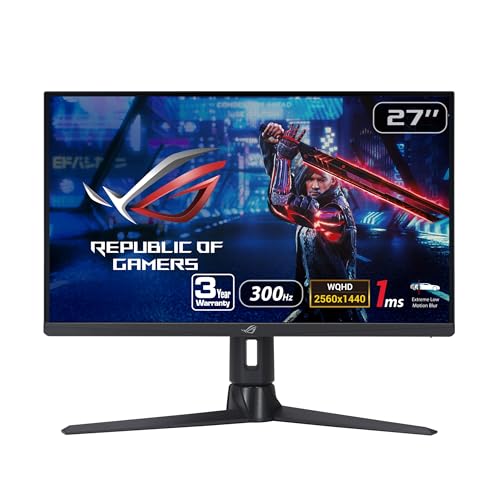
- The Modern IPS Equivalent — ASUS ROG Strix XG27AQMR: This is the direct spiritual successor to the PG278QR's high-speed legacy. It takes everything gamers loved about the original (1440p, extreme low latency, Adaptive Sync) but upgrades the panel to "Fast IPS." This means you get the lightning-fast response times of a TN panel, but with gorgeous, vibrant colors and wide viewing angles. It even pushes the refresh rate up to a blistering 300Hz, giving you an even higher competitive ceiling.
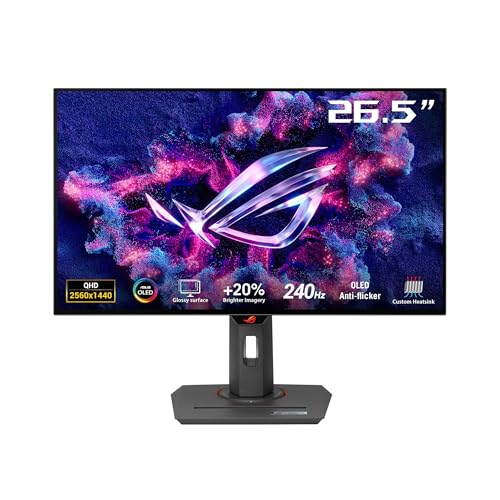
- The Ultimate Modern Upgrade — ASUS ROG Strix OLED XG27AQDMG: If you want the absolute endgame of 1440p gaming, this is it. By moving to a glossy OLED panel, ASUS eliminated motion blur entirely with a staggering 0.03ms response time while massively boosting perceived contrast. You get infinite contrast, perfect true blacks, and a 240Hz refresh rate. It is pricier, but it is hands-down the best 1440p esports monitor on the market today.
Now, let's dive into the core features that made the original PG278QR so legendary, and why these specs are still the exact baseline you should look for in your modern upgrades.
Buttery Smooth Gameplay: The 165Hz & 1ms Standard
Before the PG278QR arrived, gamers usually had to make a painful choice: buy a 1080p monitor to get high frame rates, or buy a 1440p monitor and suffer with a sluggish 60Hz refresh rate.
The PG278QR shattered that compromise by offering the 1440p (WQHD) "sweet spot" while boasting a highly overclockable 165Hz refresh rate. In competitive shooters, a higher refresh rate directly translates to smoother motion clarity. When you whip your mouse across the mousepad to flick onto a target, a 165Hz screen displays almost three times as many frames per second as a standard monitor. This drastically reduces ghosting and allows your brain to track fast-moving enemies with pin-point precision.
Paired with the 165Hz refresh rate was a strict 1ms Response Time (GtG). Because it utilized a TN panel, the pixels were able to transition from gray-to-gray almost instantly. In the heat of battle, slow pixel transition times look like a blurry smear across your screen (often called trailing or ghosting). The 1ms speed ensured that the image remained razor-sharp, even during the most chaotic team fights. Today, Fast IPS monitors (like the XG27AQMR mentioned above) achieve this same 1ms speed without sacrificing color quality.
Flawless Frames: The Power of NVIDIA G-SYNC Technology
One of the most frustrating visual artifacts in PC gaming is "screen tearing." This happens when your graphics card pumps out frames faster (or slower) than your monitor's refresh rate. The monitor ends up displaying pieces of two different frames at the same time, resulting in a literal horizontal tear across your screen.
The ASUS ROG Swift PG278QR was a pioneer in solving this issue by including a native, hardware-level NVIDIA G-SYNC module built directly into the monitor.
Unlike software-based V-Sync, which eliminates tearing but introduces heavy input lag (a death sentence in esports), G-SYNC dynamically syncs the monitor's refresh rate directly to the GPU's frame output in real-time. If your RTX graphics card pushes 142 frames per second, the monitor automatically adjusts to 142Hz. If the framerate dips to 90 during an explosion, the monitor instantly matches 90Hz.
The result? A completely tear-free, stutter-free, and seamlessly smooth gaming experience with virtually zero added input lag. This hardware module is incredibly expensive to implement, which is why it remains a premium feature exclusively found in top-tier gaming displays like the PG278QR and its modern ROG Swift replacements.
Final Thoughts
The ASUS ROG Swift PG278QR earned its place in the gaming monitor hall of fame by proving that you didn't have to sacrifice resolution to achieve esports-level speed. While its TN panel has aged out of the modern market, the DNA of this monitor lives on in the current ROG lineup. If you want to replicate its legendary performance today, you simply cannot go wrong with the ASUS ROG Strix XG27AQMR or the glossy OLED-powered ASUS ROG Strix XG27AQDMG.
About the Author

Eli Nolan
Eli is a hardware enthusiast and competitive gamer with a keen eye for technical specifications and real-world performance. With over a decade of experience in the tech industry, she specializes in deep-diving into panel technology and color accuracy. Whether it's the latest OLED breakthroughs or high-refresh-rate IPS displays, Eli is dedicated to helping gamers find the perfect screen for their battle station.